Frontispiece
Panthalassa Informatica
Frontispiece to Archipelago, and the information platform that is the state
A political philosophy based on information and its processing
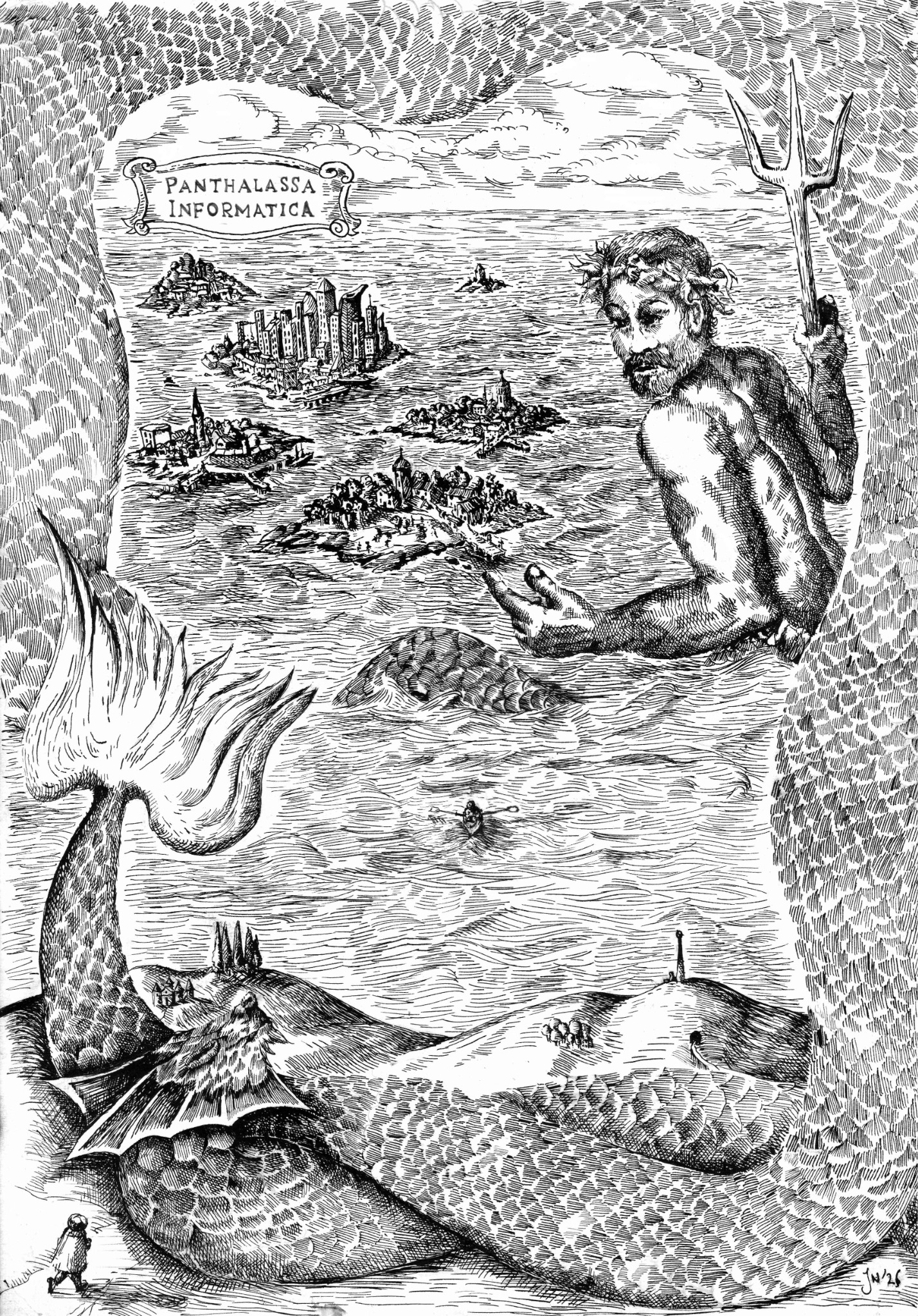
This frontispiece is meant to accompany the argument of Archipelago. It should be read together with the book’s discussion of Hobbes’s Leviathan frontispiece and of the digital world’s challenge to the older political imagination. Proteus, the ancient shapeshifting sea-deity, emerges from and merges with the informational sea — the Panthalassa Informatica — of which the archipelago is formed. The image gives visual form to the book’s underlying intuition: that political life now unfolds within an informational environment that is fluid, shared, and no longer exhausted by territory alone. In this sense, the frontispiece is not decorative. It is a visual statement of the book’s central concern with statehood, individuality, borders, and political order under digital conditions.
Note by the artist
This frontispiece was created for Archipelago, and the Information Platform that Is the State. It depicts Proteus, the ancient shapeshifting sea-deity, as a benign guiding figure rather than a sovereign. Proteus emerges from and is inseparable from the sea — here titled Panthalassa Informatica — which represents the informational space within which contemporary states exist. His body frames the scene, suggesting that the boundaries of this new political reality are no longer fixed or purely territorial, but fluid, adaptive, and sustained by information.
The islands of the archipelago are connected by the sea: some are densely urban and highly developed, others rural or sparsely populated, but all are accessible. Their relationship to one another is mediated not by land borders, but by the surrounding informational medium.
On the mainland, Proteus’s tail pins down a dead Leviathan, not the crowned, commanding figure of Hobbes’s frontispiece, but a subdued sea-monster of a previous order, referenced obliquely rather than directly. A small boatman rows away from the mainland toward the archipelago, echoing the composition of Hobbes’s image while reversing its direction of travel. In the lower left, a figure dressed in the hat and cloak of one of Hobbes’s subjects moves toward the sea, still negotiating the remains of the old order. The transition is not without obstacles, but the direction is clear.
Artist
James Nunn
Website
Download
A high-resolution download version will be added here.